 Experiments - Beta
CONP Portal | Dataset
Brainstem cholinergic-deficient mouse model dataset
| Is About: | Mus musculus |
|---|---|
| Other Dates: | This Dataset Was Published In June 2019 In The Journal Of Federation Of American Societies For Experimental Biology : 2019-06-29 00:00:00 |
Description:
Dataset README information
Cholinergic-deficient-mouse-model: Brainstem cholinergic-deficient mouse model (VAChT^En1-Cre-flox/flox)
Male mice and their wild-type controls were evaluated at 7-10 months of age using the 5-Choice Serial Reaction Time (5-CSRT) task to assess attention. Immediately after (approximately at 9-12 months of age) these same mice were evaluated using the Extinction task to assess their ability to extinguish a response. A different cohort of male mice and their wild-type controls were evaluated at 11-13 months of age in the Pairwise visual discrimination (PVD) task to assess discrimination and reversal learning. Immediately after (still within 11-13 months of age) these same mice were evaluated using the Pairwise Associate Learning (PAL) task to assess learning and memory.
COMMON METADATA:
Dataset type: Cognitive Behavioral Data from Touchscreen Technology
Source: https://mousebytes.ca
DOI: https://doi.org/10.1096/fj.201802108R
Animal Specie: Mouse
Animal Sex: Male
Animal age (month): "7-10" for 5-choice task, "11-13" for PAL, PVD, and extinction tasks
Animal strain: VAChT^En1-Cre-flox/flox
Animal Genotype: VAChT^En1-Cre-flox/flox, VAChT^flox/flox
Housing: Single-housed
Light Cycle: Diurnal light cycle
Intervention: N/A
AGGREGATED DATA:
File Name:OK_En1CreVAChTfx_5C.csv
PI: Dr. Marco Prado, Robarts Research Institute (University of Western Ontario)
Data Link: https://mousebytes.ca/data-link?linkguid=cbd657dd-3d52-4a31-b35b-b9431fc288b9
Cognitive Task: 5_Choice
Aggregation Function: Mean
Trial by Trial: No
File Name:OK_En1CreVAChTfx_PVD.csv
PI: Dr. Marco Prado, Robarts Research Institute (University of Western Ontario)
Data Link: https://mousebytes.ca/data-link?linkguid=c0127e82-6ddb-4cb6-925e-dd74f7530394
Cognitive Task: Pairwise Visual Discrimination (PVD)
Aggregation Function: Mean
Trial by Trial: No
File Name:OK_En1CreVAChTfx_PAL_acquisition.csv
PI: Dr. Marco Prado, Robarts Research Institute (University of Western Ontario)
Data Link: https://mousebytes.ca/data-link?linkguid=37543e5e-0a83-413d-a6e3-2fe15bd4950d
Cognitive Task: Paired-Associates Learning (PAL), Acquisition
Aggregation Function: Mean
Trial by Trial: No
File Name:OK_En1CreVAChTfx_PAL_analysis.csv
PI: Dr. Marco Prado, Robarts Research Institute (University of Western Ontario)
Data Link: https://mousebytes.ca/data-link?linkguid=82ea3267-92dd-40d0-bb14-8f04dc1f2f55
Cognitive Task: Paired-Associates Learning (PAL), Analysis
Aggregation Function: Mean
Trial by Trial: No
File Name:OK_En1CreVAChTfx_Extinction_training.csv
PI: Dr. Marco Prado, Robarts Research Institute (University of Western Ontario)
Data Link: https://mousebytes.ca/data-link?linkguid=be379ef0-78a0-4839-b08c-7a143e180ed4
Cognitive Task: Extinction, Training
Aggregation Function: Mean
Trial by Trial: No
File Name:OK_En1CreVAChTfx_Extinction_probe.csv
PI: Dr. Marco Prado, Robarts Research Institute (University of Western Ontario)
Data Link: https://mousebytes.ca/data-link?linkguid=ffed86b9-87c4-4b19-a737-19e01d1fb644
Cognitive Task: Extinction, Probe
Aggregation Function: Mean
Trial by Trial: No
TRIAL BY TRIAL DATA:
File Name: OK_En1CreVAChTfx_5C_Trial.csv
PI: Dr. Marco Prado, Robarts Research Institute (University of Western Ontario)
Data Link: https://mousebytes.ca/data-link?linkguid=7b6798f6-422e-4e0f-a3fc-eb798414d89c
Cognitive Task: 5_Choice
Aggregation Function: N/A
Trial by Trial: Yes
File Name: OK_En1CreVAChTfx_PD_Trial.csv
PI: Dr. Marco Prado, Robarts Research Institute (University of Western Ontario)
Data Link: https://mousebytes.ca/data-link?linkguid=6ee1b933-e724-4d98-9229-1b231596d210
Cognitive Task: Pairwise Visual Discrimination (PVD)
Aggregation Function: N/A
Trial by Trial: Yes
File Name: OK_En1CreVAChTfx_PAL_acquisition_Trial.csv
PI: Dr. Marco Prado, Robarts Research Institute (University of Western Ontario)
Data Link: https://mousebytes.ca/data-link?linkguid=e03fd89c-9956-4290-9b98-ffe7272afdd4
Cognitive Task: Paired-Associates Learning (PAL), Acquisition
Aggregation Function: N/A
Trial by Trial: Yes
File Name: OK_En1CreVAChTfx_Extinction_training_Trial.csv
PI: Dr. Marco Prado, Robarts Research Institute (University of Western Ontario)
Data Link: https://mousebytes.ca/data-link?linkguid=25ece7a3-f192-454b-b95a-02e3162fd8a9
Cognitive Task: Extinction, Training
Aggregation Function: N/A
Trial by Trial: Yes
File Name: OK_En1CreVAChTfx_Extinction_probe_Trial.csv
PI: Dr. Marco Prado, Robarts Research Institute (University of Western Ontario)
Data Link: https://mousebytes.ca/data-link?linkguid=58127af1-b693-4bd5-b0ed-f15c8cfd08ae
Cognitive Task: Extinction, Probe
Aggregation Function: N/A
Trial by Trial: Yes
Download Using DataLad

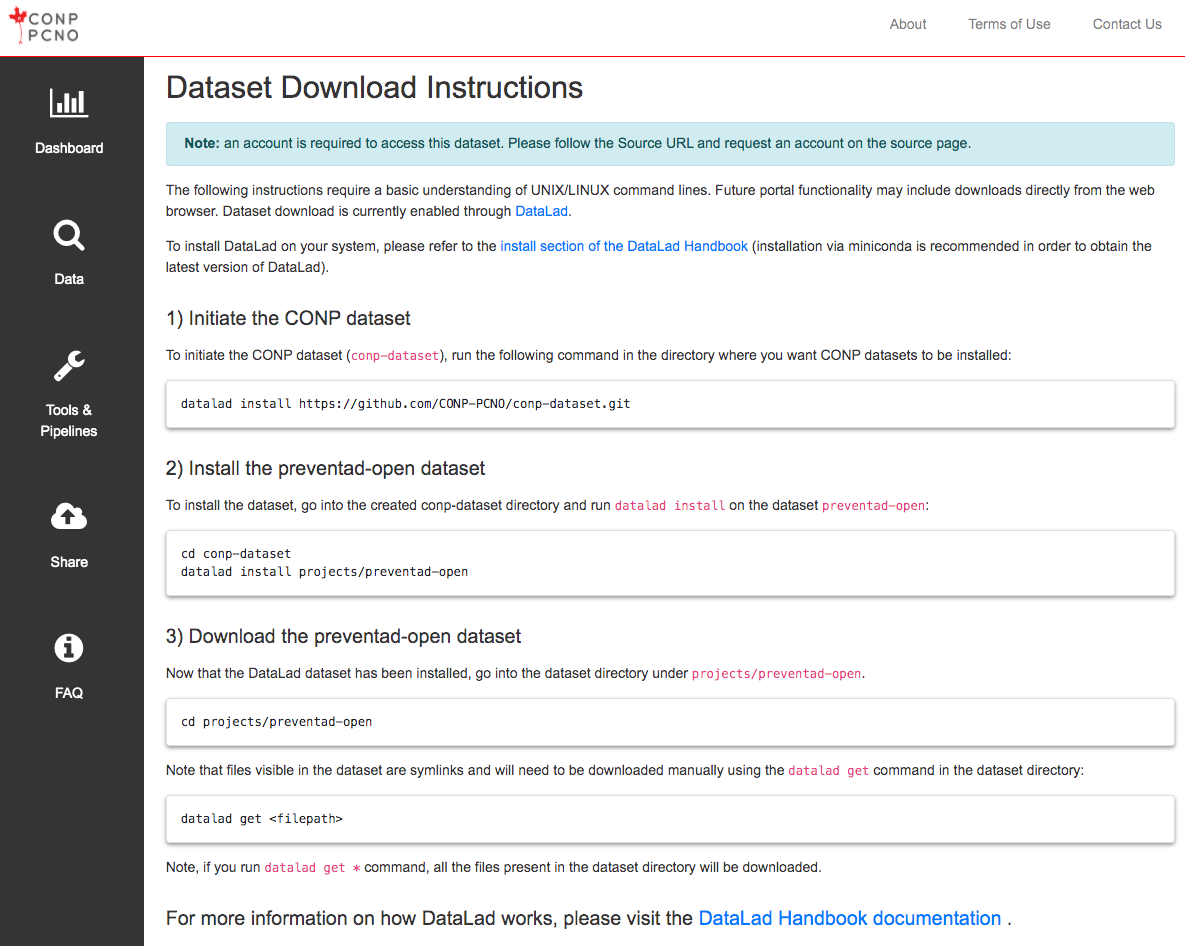
The following instructions require a basic understanding of UNIX/LINUX command lines. A subset of open datasets on the Portal are also available through a browser-based download button. The instructions below regard dataset download with the use of DataLad. To install DataLad on your system, please refer to the install section of the DataLad Handbook .
Note: For maximum compatibility with conp-dataset, the CONP recommends versions 3.12+ of Python, 10.20241202+ of git-annex, and 1.1.4+ of datalad.
1) Initiate the CONP dataset
Run the following command in the directory where you want the CONP dataset (conp-dataset) to be installed:
2) Install the mousebytes/MB-Cholinergic-deficient-mouse-model dataset
To install the mousebytes/MB-Cholinergic-deficient-mouse-model dataset, run the following commands to move into the "projects" subdirectory under the "conp-dataset" directory (created in the previous step) and run datalad install:
3) Download data from the mousebytes/MB-Cholinergic-deficient-mouse-model dataset
Now that the dataset has been installed, go into the mousebytes/MB-Cholinergic-deficient-mouse-model dataset directory.
The files visible after installing the dataset but before downloading (in the next step) are symbolic links and need to be downloaded manually using the datalad get command:
If you run datalad get * command, all the files available in the dataset directory will be downloaded.